
Your Data is a → Sleeping Giant
From Educated Guesses to → Strategic Foresight
Bardioc OSINT reveals what was previously hidden: patterns, signals, and correlations — the ‘unknown unknowns’ that conventional analysis misses and that often reduce the precision, depth, and speed of business decisions.
Open-Source Intelligence
Companies are under increasing pressure to make informeddata-driven decisions. That requires more than internal reporting alone. Only by incorporating publicly available information can organizations build a broader view of markets, risks, and trends for strategic decision-making.
This is where Open Source Intelligence (OSINT) comes in. It is the systematic collection and analysis of publicly available information. Combined with internal data, it creates a robust foundation for strategic decision-making.
Noise, silos, lack of context: Too much data, too little reasoning
Companies have more data than ever before — yet traditional analytical approaches can only synthesize it into a reliable overall picture with significant effort and limited scalability. As the interplay between markets, politics, and macroeconomic dynamics becomes more complex, relevant connections, new causal relationships, and unexpected signals remain hidden. As a result, analysis remains reactive where strategy should be proactive.
The Semantic Platform that Turns Dispersed Data into Strategic Dominance
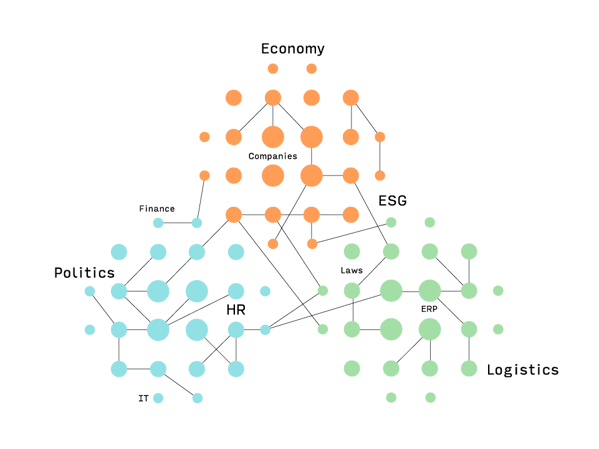
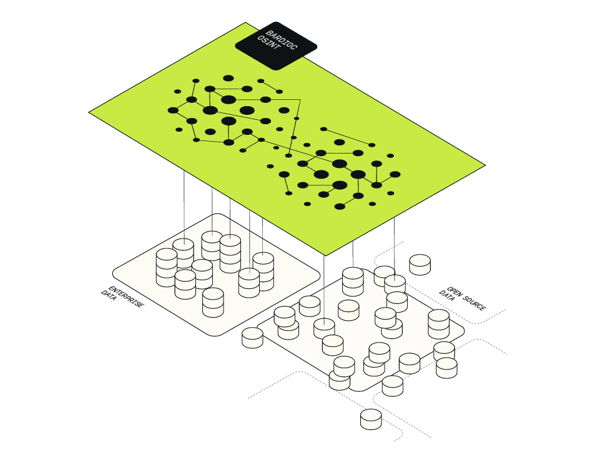
The Bardioc OSINT platform links public OSINT sources and internal company data within a shared semantic data space. Built on an ontology and a dynamic knowledge graph, the platform not only collects information but also structures, contextualizes, and connects it across data sets. This means that complex strategic questions can be answered in seconds, unexpected patterns become visible across domains and data boundaries, and knowledge can be reused across projects and departments.
Data has Entered the Chat
Data is everywhere. However, its true value only emerges when it is linked meaningfully and coherently — for example, by correlating internal CRM data, business KPIs, and product information with external data on demographics, political events, and financial trends.
Only when these two sides are brought together in a shared space of meaning does scattered information become strategic intelligence. This is exactly where Bardioc comes in: not with even more sources, but with a decisive increase in context.